The term atom comes from the Greek, which means it can not be cut or something that can not be divided again. The concept of the atom as a component that can not be divided again was first proposed by the philosophers of India and Greece. In the 17th century and into the 18th, the chemists laid the foundations of this idea by showing that certain substances can not be broken down further using chemical methods. During the late nineteenth century and early twentieth century, physicists have managed to find the structure and subatomic components inside the atom, to prove that the 'atom' is not never be divided again. The principles of quantum mechanics are used The physicists then successfully model the atom.
Relative to daily observations, the atoms are very small objects with masses as minor anyway. Atoms can only be monitored using special equipment such as tunneling microscope Microscopy. More than 99.9% of the mass of the atom is concentrated in the nucleus, the proton and neutron are almost the same mass. Each element has at least one isotope with unstable nuclei that can undergo radioactive decay. This can lead to transmutation that changes the number of protons and neutrons in the nucleus. Electrons are bound to the atom contains a number of energy cedar, or orbital, which is stable and can undergo transitions between these cedar by absorbing or emitting photons that match the energy difference between the levels. The electrons in the atom determines the chemical properties of an element and affect the magnetic properties of the atom.
Development of Atomic Model
A Greek philosopher named Democritus argued that if an object is cut continuously, then at a given moment will get will get a part that can not be split again. Parts like this by Democritus called atoms. The term atom comes from the Greek "a" which is not, while the "Tomos" which means split. So, it means atoms can not be subdivided. This understanding is then refined into an atom is the smallest part of an element that can not be cut anymore, but yet it still has chemical and physical properties of the object origin.
Atoms denoted by ZXA, where A = mass number (atomic mass indicates, is the number of protons and neutrons), Z = atomic number (indicating the number of electrons or protons). Protons are positively charged, uncharged neutrons (neutral), and negatively charged electrons. The mass of a proton = mass of neutron = 1,800 times the mass of the electron. Atoms that have the same atomic number and different mass numbers are called isotopes, atoms that have the same mass number and atomic number of different so-called isobar, atoms that consists of equal numbers of neutrons called isoton.
Kinds of Model Atom
Dalton said that atoms like a solid ball or a ball shot put JJ.Thomson say that ATOMM like raisin bread E.Rutherford atom like the solar system suggests
1. John Dalton Atomic Model
In 1808, John Dalton, who is a teacher in the UK, contemplating on the atom. Results reflection refine Dalton's atomic theory of Democritus. Shadow Dalton and Democritus is that the atoms of solid shape. In Dalton argued postulatnya musings about atoms:
Each element is composed of extremely small particles called atoms with
Atoms of the same element the same properties memiliiki
Atoms of different elements have different properties
Atoms of an element can not be converted into atoms of another element with the chemical reaction, atoms can not be destroyed and the atoms also can not be destroyed
Atoms can combine to form atoms called molecules combined
In the compound, the mass ratio of each element is fixed
Dalton's atomic theory began to arouse interest in the study of atomic models. However, Dalton's atomic theory has shortcomings, which can not explain a solution to conduct electrical current. How could solid ball can conduct electricity when electricity is electrons moving. Meaning there are other particles that can conduct electric current.
Each element is composed of extremely small particles called atoms with
Atoms of the same element the same properties memiliiki
Atoms of different elements have different properties
Atoms of an element can not be converted into atoms of another element with the chemical reaction, atoms can not be destroyed and the atoms also can not be destroyed
Atoms can combine to form atoms called molecules combined
In the compound, the mass ratio of each element is fixed
Dalton's atomic theory began to arouse interest in the study of atomic models. However, Dalton's atomic theory has shortcomings, which can not explain a solution to conduct electrical current. How could solid ball can conduct electricity when electricity is electrons moving. Meaning there are other particles that can conduct electric current.
2. J.J. Atom Model Thomson
The downside of Dalton repaired by JJ. Thomson, experiments are done kotoda ray tube. The results of experiments stated there negatively charged particles called electrons in atoms. A ball of solid surface surrounded by electrons and other particles that are positively charged atom is neutral. Thomson model of atom images:
Weakness Thomson models can not explain the arrangement of positive and negative charges within the atomic sphere.
Weakness Thomson atomic model
Thomson's model can not explain the arrangement of positive and negative charges within the atomic sphere.
The downside of Dalton repaired by JJ. Thomson, experiments are done kotoda ray tube. The results of experiments stated there negatively charged particles called electrons in atoms. A ball of solid surface surrounded by electrons and other particles that are positively charged atom is neutral. Thomson model of atom images:
Weakness Thomson models can not explain the arrangement of positive and negative charges within the atomic sphere.
Weakness Thomson atomic model
Thomson's model can not explain the arrangement of positive and negative charges within the atomic sphere.
3. Rutherford Atom Model
Rutherford conducted a study on α-ray scattering on gold plates. Observations were developed in the Rutherford atomic model hypothesis.
a. Most of the atom is empty surface.
b. Atom has a positively charged nucleus which is the center of mass of the atom.
c. Electrons move around the nucleus at a very high speed.
d. Most of the α particles pass without having distorting / barriers. A small portion deflected, and little is reflected.
Weakness Rutherford Atom Model
a. According to the laws of classical physics, electrons moving around the nucleus emits energy in the form of electromagnetic waves. As a result, the electron eventually it will run out of energy and eventually attached to the core.
b. Rutherford atomic model has not been able to explain where the location of the electron and the way the rotation of the nucleus.
c. Electrons emit energy when moving, so the energy of the atom becomes unstable.
d. Unable to explain the line spectrum of hydrogen atoms (H).
Rutherford conducted a study on α-ray scattering on gold plates. Observations were developed in the Rutherford atomic model hypothesis.
a. Most of the atom is empty surface.
b. Atom has a positively charged nucleus which is the center of mass of the atom.
c. Electrons move around the nucleus at a very high speed.
d. Most of the α particles pass without having distorting / barriers. A small portion deflected, and little is reflected.
Weakness Rutherford Atom Model
a. According to the laws of classical physics, electrons moving around the nucleus emits energy in the form of electromagnetic waves. As a result, the electron eventually it will run out of energy and eventually attached to the core.
b. Rutherford atomic model has not been able to explain where the location of the electron and the way the rotation of the nucleus.
c. Electrons emit energy when moving, so the energy of the atom becomes unstable.
d. Unable to explain the line spectrum of hydrogen atoms (H).
4. Niels Bohr Atom Model
In 1913, Niels Bohr expressed the opinion that the electrons moving around the nucleus in certain paths called shells. [4] Bohr's atomic model is a refinement of the atomic model of Rutherford.
Rutherford's atomic theory weaknesses corrected by Neils Bohr to postulate Bohr:
a. Electrons surrounding the nucleus has a certain trajectory and energy.
b. In particular orbital, the electron energy is fixed. The electrons will absorb energy when moving to the outer orbit and will release energy when moving deeper into orbit
Excess Bohr model of the atom
atom consists of a few skins for a transfer of electrons.
Weakness Bohr model of the atom
a. can not explain the Zeeman effect and the effect Strack.
b. Unable to explain the events of the chemical bond well, the influence of magnetic fields on atoms and atomic electron spectrum more.
In 1913, Niels Bohr expressed the opinion that the electrons moving around the nucleus in certain paths called shells. [4] Bohr's atomic model is a refinement of the atomic model of Rutherford.
Rutherford's atomic theory weaknesses corrected by Neils Bohr to postulate Bohr:
a. Electrons surrounding the nucleus has a certain trajectory and energy.
b. In particular orbital, the electron energy is fixed. The electrons will absorb energy when moving to the outer orbit and will release energy when moving deeper into orbit
Excess Bohr model of the atom
atom consists of a few skins for a transfer of electrons.
Weakness Bohr model of the atom
a. can not explain the Zeeman effect and the effect Strack.
b. Unable to explain the events of the chemical bond well, the influence of magnetic fields on atoms and atomic electron spectrum more.
Know Experiments Atomic Structure
1. electron
Cathode ray tube experiment was first performed by William Crookes (1875). Results with experiments is found that a beam of light emerging from the cathode into the anode called cathode rays.
George Johnstone Stoney (1891) proposed the name cathode rays yand called "electrons". The downside of stoney can not account for the effect of the differences in the properties of electrons between atoms of an element with atoms in the other elements. Antonine Henri
Beecqerel (1896) found that the light emitted from radioaktof elements that are similar to electrons.
Joseph John Thomson (1897) continued experimentation William Crookes, namely the influence of an electric field and a magnetic field in the cathode ray tube.
1. electron
Cathode ray tube experiment was first performed by William Crookes (1875). Results with experiments is found that a beam of light emerging from the cathode into the anode called cathode rays.
George Johnstone Stoney (1891) proposed the name cathode rays yand called "electrons". The downside of stoney can not account for the effect of the differences in the properties of electrons between atoms of an element with atoms in the other elements. Antonine Henri
Beecqerel (1896) found that the light emitted from radioaktof elements that are similar to electrons.
Joseph John Thomson (1897) continued experimentation William Crookes, namely the influence of an electric field and a magnetic field in the cathode ray tube.
The experimental results JJ Thomson showed that cathode rays could be deflected toward the positive pole of the electric field. This proves there is a negatively charged particles in an atom.
The amount of the charge in eletron discovered by Robert Andreww have (1908) through ownership Oil drops trial.
The amount of the charge in eletron discovered by Robert Andreww have (1908) through ownership Oil drops trial.
Oil sprayed into the tube charged litrik. Due to an attractive force of gravity would precipitate the fall of oil droplets. if the droplet
oil given the negative charge will be attracted to the positive pole electric field. From the experimental results obtained ownership and Thomson electron charge and mass of the electron-1 0.
oil given the negative charge will be attracted to the positive pole electric field. From the experimental results obtained ownership and Thomson electron charge and mass of the electron-1 0.
2. proton
If the mass of the electron 0 shall mean a particle has no mass. But in fact it has a mass of particulate matter that can be measured and the atoms are neutral atoms. Eugene Goldstein (1886) conducted experiments from the gas cylinder that has a cathode, which was given the holes and electric charge.
The experimental results prove that formed when electrons toward the anode, also formed a positive light towards the opposite direction through the hole in the cathode. After trying various gases in the tube, the gas turns hidrogenlah that produces beams of the smallest positive charge both mass and muatanya, so that particles called protons. The mass of a proton = 1 sma (atomic mass units) and the proton charge = +1
If the mass of the electron 0 shall mean a particle has no mass. But in fact it has a mass of particulate matter that can be measured and the atoms are neutral atoms. Eugene Goldstein (1886) conducted experiments from the gas cylinder that has a cathode, which was given the holes and electric charge.
The experimental results prove that formed when electrons toward the anode, also formed a positive light towards the opposite direction through the hole in the cathode. After trying various gases in the tube, the gas turns hidrogenlah that produces beams of the smallest positive charge both mass and muatanya, so that particles called protons. The mass of a proton = 1 sma (atomic mass units) and the proton charge = +1
3. The nucleus
After the discovery of the proton and electron, Ernest Rutherford conducted a study of gold thin arduous shooting. If the atom consists of a positively charged particles and negatively the alpha rays are fired should not be forwarded / pierce plate so mincullah terms of atomic nuclei. Ernest Rutherford assisted by Hans Geiger and Ernest Marsden (1911) found the nucleus concept is supported by the discovery of X-rays by WC. Rontgen (1895) and the discovery of radioactive substances (1896).
After the discovery of the proton and electron, Ernest Rutherford conducted a study of gold thin arduous shooting. If the atom consists of a positively charged particles and negatively the alpha rays are fired should not be forwarded / pierce plate so mincullah terms of atomic nuclei. Ernest Rutherford assisted by Hans Geiger and Ernest Marsden (1911) found the nucleus concept is supported by the discovery of X-rays by WC. Rontgen (1895) and the discovery of radioactive substances (1896).
The results of this experiment make Rutherford stated hypothesis that the atom consists of a positively charged nucleus surrounded by negatively charged electrons, so the atom is neutral. The mass of the nucleus is not equal to the mass of protons in the atomic nucleus, so that DAPT predicted that there is another particle in the nucleus of an atom.
4. neutron
Prediction of triggering W. Rutherford Bothe and H. Becker (1930) conducted experiments on atomic nuclei particle bombardment of beryllium (Be) and the resulting high penetrating power of radiation particles.
James Chadwick (1932). It turns out the particles that cause the high penetrating power of radiation is nertal or uncharged and almost equal to the proton mass. These particles called neutrons and denoted.
Prediction of triggering W. Rutherford Bothe and H. Becker (1930) conducted experiments on atomic nuclei particle bombardment of beryllium (Be) and the resulting high penetrating power of radiation particles.
James Chadwick (1932). It turns out the particles that cause the high penetrating power of radiation is nertal or uncharged and almost equal to the proton mass. These particles called neutrons and denoted.
Determining Atomic Structure Based on the Periodic Table
1. Drafting Basic Atomic Particles
Atom is the smallest part of an element that still has the properties of that element. The atomic structure describes how the particles in atoms are composed, made up of atoms and atomic nuclei surrounded by electrons scattered in the skin-skin. Can systematically described subatomic particles following.
1. Drafting Basic Atomic Particles
Atom is the smallest part of an element that still has the properties of that element. The atomic structure describes how the particles in atoms are composed, made up of atoms and atomic nuclei surrounded by electrons scattered in the skin-skin. Can systematically described subatomic particles following.

Most of the atom consists of a vacuum chamber where there is a very small nucleus where mass and positive charge centered and surrounded by electrons are negatively charged. The nucleus is made up of a number of protons and neutrons. The number of protons in the nucleus determines the atomic nuclear charge, while the atomic mass of the core is determined by the number of protons and neutrons. The next three sub-atomic particles (protons, neutrons, and electrons) view of a particular combination of atoms forming the symbol of an element can be written:
X: the symbol of an element
Z: atomic number
A: mass number
X: the symbol of an element
Z: atomic number
A: mass number
2. Understanding the Structure of An Atom Look at the number of the periodic table. The atomic number is always smaller than the number of mass labih
The atomic number is the number of protons. Because of the nature of a neutral atom, the atomic number is also the number of electrons
Arrangement of electrons in energy levels, always fill the deepest level before filling the outer level
Two things are important to note if you look at the periodic table arrangement daam.
The number of levels of the outer electrons (or outer shell) is the same as the group number (except helium which has two electrons. Commonly called the noble gases golonga 0 instead of class 8). This applies throughout the group elements in the periodic table (except for the transition elements). So, if you know that barium is in group 2, bearti have 2 electrons in barium teluar level.
Noble gases have electrons in its outer level
The atomic number is the number of protons. Because of the nature of a neutral atom, the atomic number is also the number of electrons
Arrangement of electrons in energy levels, always fill the deepest level before filling the outer level
Two things are important to note if you look at the periodic table arrangement daam.
The number of levels of the outer electrons (or outer shell) is the same as the group number (except helium which has two electrons. Commonly called the noble gases golonga 0 instead of class 8). This applies throughout the group elements in the periodic table (except for the transition elements). So, if you know that barium is in group 2, bearti have 2 electrons in barium teluar level.
Noble gases have electrons in its outer level
Atomic Number and Mass Number
An atom has a mass of distinctive nature and each other. With the discovery of subatomic particles known term atomic number (Z) and mass number (A)
Writing equalizes wave of atoms of element atomic number and mass number.
where:
A = mass number
Z = atomic number
X = symbol elemen
Mass Number (A) = number of protons + number of neutrons
or Number of neutrons = mass number - atomic number
An atom has a mass of distinctive nature and each other. With the discovery of subatomic particles known term atomic number (Z) and mass number (A)
Writing equalizes wave of atoms of element atomic number and mass number.
where:
A = mass number
Z = atomic number
X = symbol elemen
Mass Number (A) = number of protons + number of neutrons
or Number of neutrons = mass number - atomic number
Atomic number (Z) = number of protons
1. Atomic number (Z)
Atomic number (Z) shows the number of protons (positive charge) or the number of electrons in the atom. The atomic number is characteristic of an element. Because atoms are neutral, the number of protons equal to the number elektronya, so the atomic number also showed the number of electrons. Electron is what will most determine the properties of an element. The atomic number is written slightly downward before the element symbol
2. Mass Number (A)
Electron mass is very small and is considered zero and the mass of the atom is determined by the nucleus of protons and neutrons. The mass number (A) specifies the number of protons and neutrons that make up the nucleus of an atom of an element. The mass number is written slightly upwards before the symbol of the element.
Atomic number (Z) shows the number of protons (positive charge) or the number of electrons in the atom. The atomic number is characteristic of an element. Because atoms are neutral, the number of protons equal to the number elektronya, so the atomic number also showed the number of electrons. Electron is what will most determine the properties of an element. The atomic number is written slightly downward before the element symbol
2. Mass Number (A)
Electron mass is very small and is considered zero and the mass of the atom is determined by the nucleus of protons and neutrons. The mass number (A) specifies the number of protons and neutrons that make up the nucleus of an atom of an element. The mass number is written slightly upwards before the symbol of the element.
Isotopes, Isobar, and Isoton an element
1. isotope
Isotopes are atoms that have the same number but have different mass numbers
Each isotope of an element have the same chemical properties as the number of valence electrons equal.
Isotopes can be used to determine the relative atomic mass (Ar) atom is based on the isotope abundances and atomic mass of all isotopes
2. Isobar
Isobar is the elements that have an atomic number but different mass numbers together.
3. Isoton
The atoms are different but have the same number of neutrons
1. isotope
Isotopes are atoms that have the same number but have different mass numbers
Each isotope of an element have the same chemical properties as the number of valence electrons equal.
Isotopes can be used to determine the relative atomic mass (Ar) atom is based on the isotope abundances and atomic mass of all isotopes
2. Isobar
Isobar is the elements that have an atomic number but different mass numbers together.
3. Isoton
The atoms are different but have the same number of neutrons
Determining Valence Electrons
1. Electron configuration
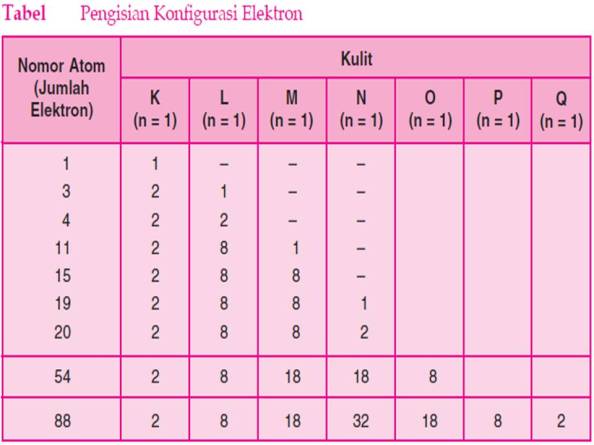
Configuration (arrangement) of electrons of an atom by atom shells. Each atom can be charged a maximum eletron 2N2, where n is the location of the skin.
Coat the skin starts from the K, L, M, N and so starting from the closest to the nucleus.
Electrons arranged in such a way on their own skins and stuffed maximum capacity of the skin suit. So there is the rest of their electrons can not be accommodated on the skin then placed next to the skin.
1. Electron configuration
Configuration (arrangement) of electrons of an atom by atom shells. Each atom can be charged a maximum eletron 2N2, where n is the location of the skin.
Coat the skin starts from the K, L, M, N and so starting from the closest to the nucleus.
Electrons arranged in such a way on their own skins and stuffed maximum capacity of the skin suit. So there is the rest of their electrons can not be accommodated on the skin then placed next to the skin.
2. Valence electrons
Electrons are involved in chemical bond formation reactions and chemical reactions are electrons in the outer shell or valence electrons.
The number of valence electrons of an atom is determined by the electrons contained in the last shell electron configuration of the atom. Note the table to determine the number of valence electrons
Electrons are involved in chemical bond formation reactions and chemical reactions are electrons in the outer shell or valence electrons.
The number of valence electrons of an atom is determined by the electrons contained in the last shell electron configuration of the atom. Note the table to determine the number of valence electrons

The elements that have the same number of valence electrons will have the same chemical properties as well.


 ]
]


